Stop Applying and Start Connecting: Your Networking Strategy

Networking is often misunderstood as a “who you know” game. In reality, it is a deliberate, proactive strategy to understand the marketplace, refine your value proposition, and identify the gaps where your skills are most needed.
According to groundbreaking research from Stanford, MIT, Harvard, and LinkedIn, “the greatest job mobility comes from moderately weak ties” (those social connections between your closest friends and complete strangers).
If you are waiting for a job to appear on a job board to start networking, you are already behind the curve. Here is how to build a robust networking foundation that will serve you throughout your career.
1. Redefining Your Network: The 10 Types of People to Approach
Many people limit their networking to industry peers. This is a mistake. To broaden your reach, you need to be methodical. Start by documenting the names of people you already know, and then expand your list using these ten critical categories:
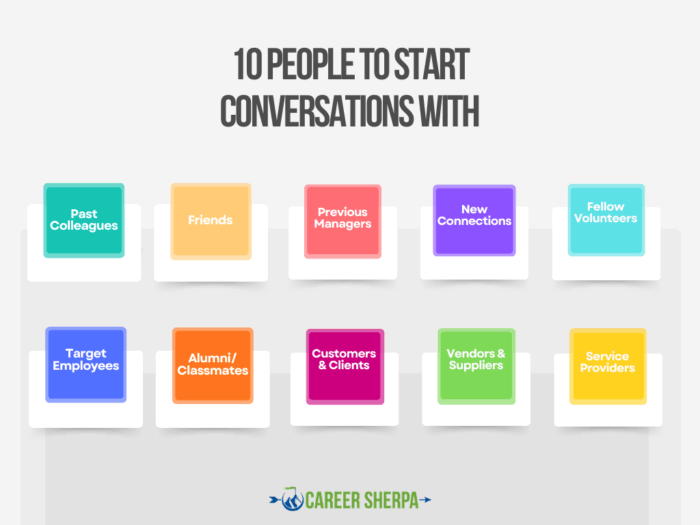
- Past Colleagues: They have seen your work ethic in action. They are your best eyes and ears for internal company shifts.
- Friends: They possess a “hidden network” you haven’t yet tapped into. Don’t underestimate their ability to connect you.
- Previous Managers: Assuming a positive relationship, they are often the first to know about upcoming opportunities.
- New Connections: If you meet someone at an event with shared synergy, secure a follow-up conversation immediately. Don’t let the lead go cold.
- Target Company Employees: Want to work at a specific company? Talk to the people inside to learn the real culture before you apply.
- Alumni & Classmates: Leverage school databases or LinkedIn’s “See Alumni” feature. This is a “warm” introduction waiting to happen.
- Customers & Clients: They know your value and understand the industry landscape.
- Vendors & Suppliers: They have a pulse on the industry because they service multiple companies within it.
- Service Providers: Doctors, accountants, and hair stylists have their own vast, diverse networks.
- Fellow Volunteers: Organizations are built on relationships; tap into the community of board members and sponsors.
2. Mastering the Art of the “Pitch”
“What do you do?” It is the most common question in networking, and it is your single biggest opportunity. You need an “elevator pitch”. It’s a succinct, 15 to 60-second summary that explains your value.
The 7-Step Pitch Framework:
- Define your goal: What role are you interested in?
- Highlight your industry experience: How do you translate your past into your future?
- Solve the problem: Focus on the skills you use to solve problems, not just your job titles.
- Show your impact: What results did you create in your last role? (e.g., “I cut production time by 20%”).
- End with a question: Keep the conversation moving.
- Deliver with energy: Smile and show excitement; people want to hire humans, not robots.
- Identify what the employer needs: Research the role, look for keywords in job descriptions, and tailor your pitch to show how you meet those specific needs.
You may not know exactly what job title you are pursuing or where you want to do it, but you can still start having conversations to find that out!
Template:
“I am pursuing a career as a [job title/occupation]. My experience has been [industry/role]. This gave me the opportunity to [skills used or problem solved]. I’ve been successful [what solutions you offer]. For my next role, I would like to focus on [specific problems/work processes].”
The clearer you are in what you want to do, the better information (and possibly leads) you will receive. If your conversations are not generating additional names of people or companies, then you need to work on the clarity of your pitch (what you are looking for and what value you deliver).
3. Building Your Proactive Target List
Stop blindly applying to job postings. Instead, create a target list of 25–50 companies you are genuinely interested in. I wrote a whole post on how to identify target companies and how to find target company insiders.
Keep your list organized in a spreadsheet or CRM. Include company name, whether you have any connections there, your motivation (1–5 scale of interest), and the status of your job postings. Once you have your list, identify the person you have the strongest link to and reach out. When you go directly to the source of opportunities rather than the “apply” button, you arrive ahead of the competition.

Hannah Morgan speaks and writes about job search and career strategies. She founded CareerSherpa.net to educate professionals on how to maneuver through today’s job search process. Hannah was nominated as a LinkedIn Top Voice in Job Search and Careers and is a regular contributor to US News & World Report. She has been quoted by media outlets, including Forbes, USA Today, Money Magazine, Huffington Post, as well as many other publications. She is also author of The Infographic Resume and co-author of Social Networking for Business Success.