Examining overarching trends provides an invaluable overview of today’s hiring landscape, helping you benchmark expectations and make informed strategy decisions. However, broad market data won’t directly reflect every job seeker’s exact situation because every job search is unique and shaped by your specific career level, industry, target roles, and individual circumstances.
Key Takeaways
Huntr’s Q3 2026 report highlights key trends across today’s hiring landscape. Here are what I believe are the top 9 job seekers should be aware of: how long it takes to secure interviews, top sources of interview conversions, wage expectations, increasing AI skill requirements, and more!
1. Starting A Job Search Takes Momentum
You are building your job search plan from scratch, so it takes time to refine your resume, get used to applying for jobs, and build connections.
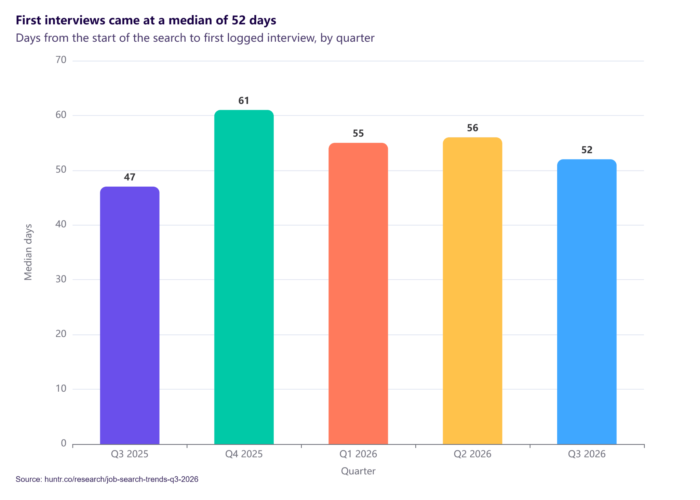
What Huntr found was that it takes 52 days to secure that first interview. This is 4 days faster than last quarter but 5 days longer than this time last year.
The bottom line is that securing your first interview will likely take longer than you want or expect!
2. Timeframe To Get A Job Offer
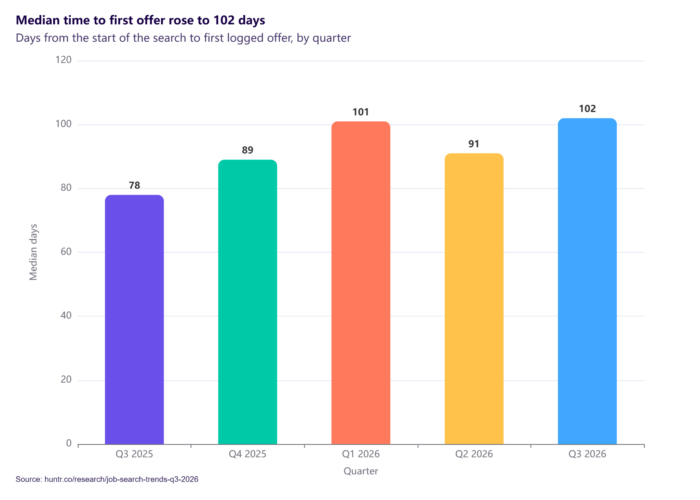
Again, to set your expectations about how long this process can take, based on other job seekers, securing that first offer takes a median of 102 days. This is the longest time to first offer in the past year.
4. Applications To Interview
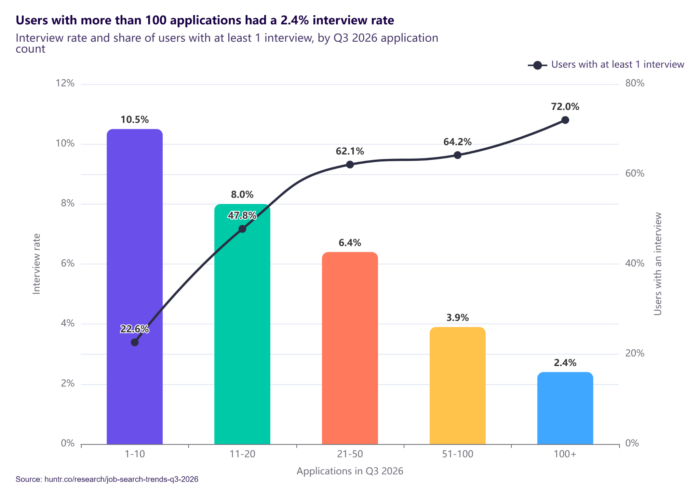
Job search is a bit of a numbers game. But as you can see, applying to more jobs did not increase the number of people securing a first interview.
What Huntr data also said was that it took 10 applications to generate an interview.
And looking at the chart below, it shows that job seekers who applied to 1-10 jobs had a 10.5% interview rate versus those who applied to 100+ jobs and had an interview rate of 2.4%
Here’s the takeaway. Quality over quantity wins. Apply for jobs you are interested in and qualified for.
5. Lower Salary Expectations
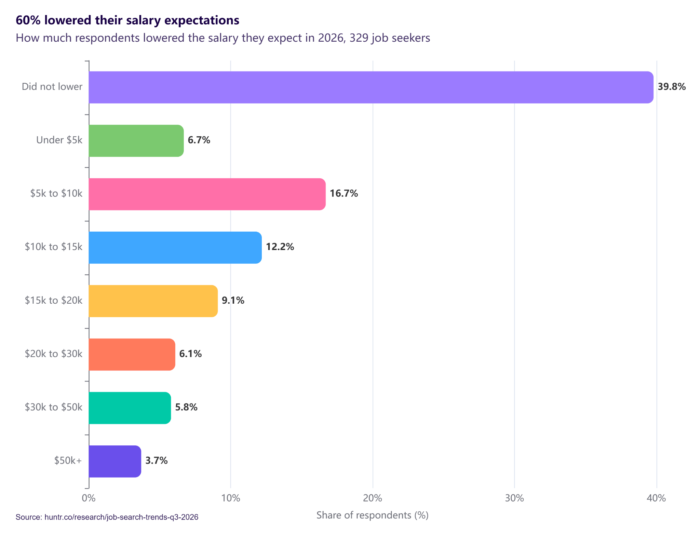
In a competitive and tight job market, job seekers are adjusting their salary expectations. 60% reported lowering their salary expectations. The majority of respondents said they would lower salary expectations by $5-$10 thousand.
6. Source of Interviews
A smart job search diversifies where job seekers look for opportunities. While not all methods have the same success rate for every job seeker, it’s important to NOT rely solely on job postings. They are an easy target and often, hiring managers are overwhelmed by the number of applications.
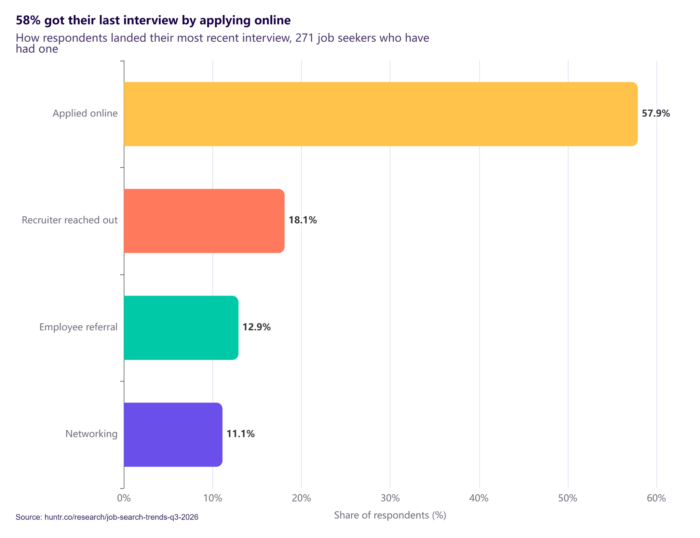
- 58% got an interview by applying online
- 18% said a recruiter reached out
- 13% had an employee referral
- 11% credited networking
One of the things that has always been difficult to prove is a single source. Sometimes people will see a job online and apply, then speak with a person they know inside the company. When reporting how they got their interview, do they credit the application or the referral?
For this reason, it’s important to keep in mind that more than one of these methods can contribute to securing an interview.
7. Top Job Sites for Job Interviews
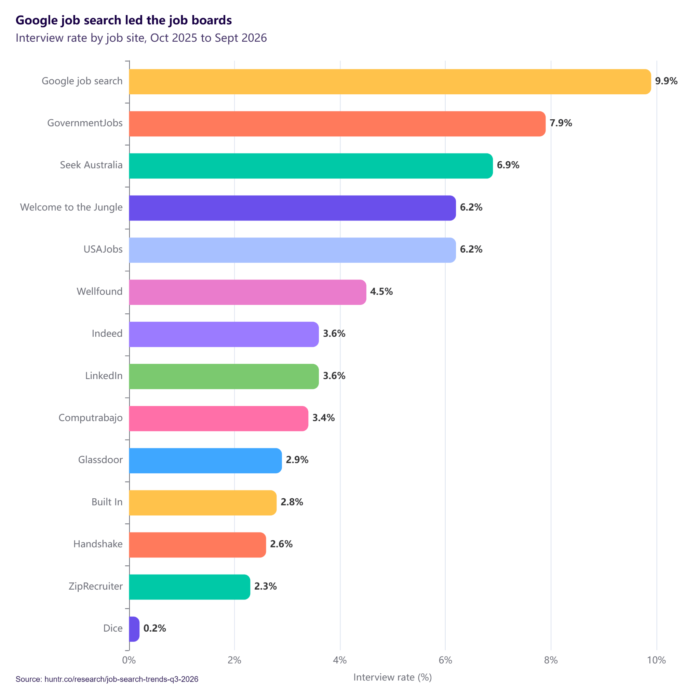
Many job seekers rely on a single job board/site to uncover opportunities. And the sites they use matter, as Huntr’s data shows.
Recruiters and companies have different strategies for posting job openings. If you aren’t aware of the job site a company uses to announce openings, you may miss it. That’s where Google comes in. It searches every major job board to help you discover opportunities you may have missed. This is probably why Google has the highest interview conversion rate.
- 9.9% for Google Job Search
- 7.9% for GovernmentJobs
- 6.2% for Welcome to the Jungle
- 6.2% for USAJobs
- LinkedIn only has an interview rate of 3.6%
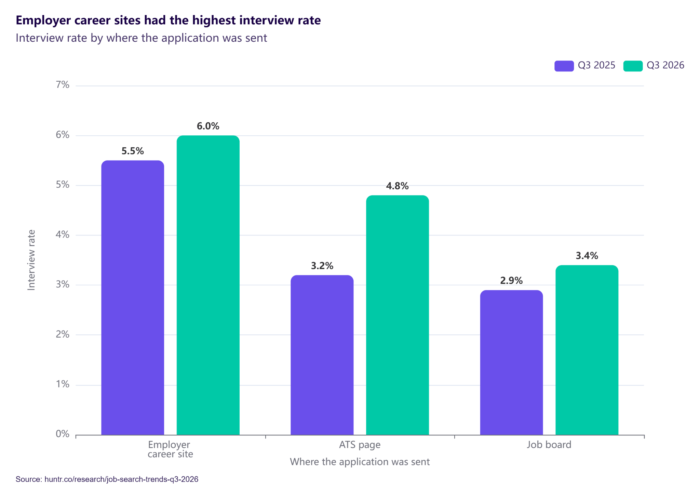
One place almost every company will post an opening is on their own company career site.
Company career sites have an even higher interview rate that job boards. Applications sent through employer career sites got interviews at 6.0%, against 4.8% through applicant tracking system (ATS) pages and 3.4% through job boards.
8. Tailor Your Resume
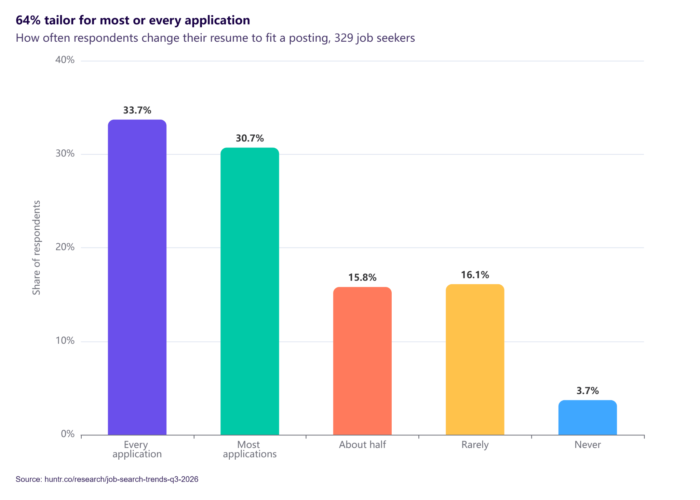
Most job seekers know it’s important to tailor their resume for the job they apply to. This chart shows that only 33% of job seekers customize their resume for every application. Overall, 64% do tailor their resume most or all the time.
9. AI Skills On the Rise in Job Ads
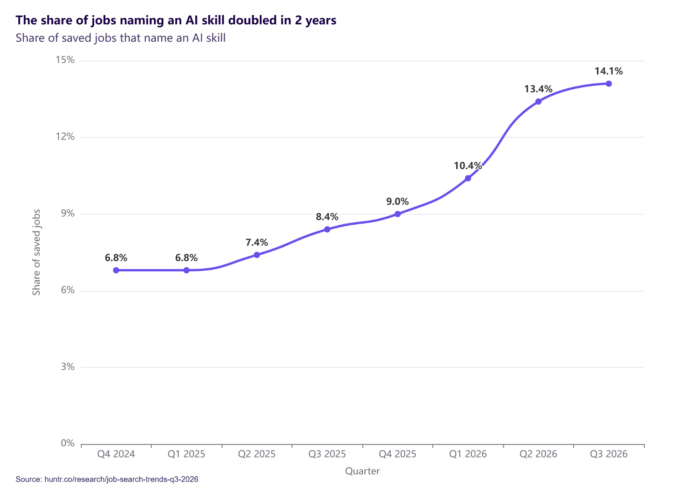
There has been a steady increase in the mention of AI skills in job postings over the past few years. What Huntr found this quarter was that 14% of job postings referenced an AI skill. In 2024, AI skills were mentioned just 7% of the time.
AI skills are more than the AI tool. AI skills can mean understanding how to ask a tool to interpret data, create a chart, summarize, etc.
It would be a good idea to see what AI skills are being mentioned in jobs you are interested in so you can begin bridging the gap.
For example, you can use AI in many ways during your job search. From research to analysis to skill identification. Be sure to rely on your own critical thinking.
Summary
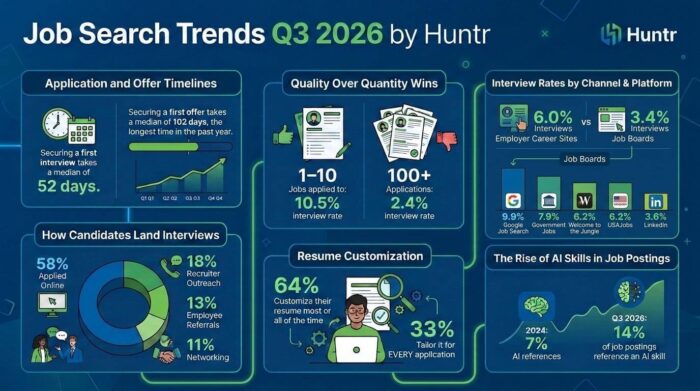
- Securing a first interview takes a median of 52 days.
- Securing a first offer takes a median of 102 days, the longest time in the past year.
- Quality over quantity wins, with candidates applying to 1–10 jobs yielding a 10.5% interview rate compared to 2.4% for 100+ applications.
- 60% of job seekers reported lowering their salary expectations, most commonly by $5k–$10k.
- 58% of candidates landed their last interview by applying online, followed by recruiter outreach (18%), employee referrals (13%), and networking (11%).
- Google Job Search led all job sites with a 9.9% interview conversion rate, while employer career sites outperformed job boards at 6.0% vs. 3.4%.
- 64% of job seekers customize their resume most or all of the time, with 33% tailoring it for every application.
- 14% of job postings referenced an AI skill. In 2024, AI skills were mentioned just 7% of the time.
Where Does The Data Come From?
Drawing from a dataset of 152,742 saved jobs, 84,753 applications, and feedback from 329 survey responses, Huntr’s Q3 2026 report highlights key trends across today’s hiring landscape.
Geographically, the United States leads with 51.1% of location-specified listings, followed by Colombia, Germany, Canada, and the United Kingdom. Sector-wise, Internet Software & Services represents the largest share at 31.9%, with Professional Services comprising 16.5%.
In terms of candidate experience, 44.5% of resumes targeted entry-level roles, 22.8% focused on mid-level positions, and 32.7% aimed at senior-level opportunities.

Hannah Morgan speaks and writes about job search and career strategies. She founded CareerSherpa.net to educate professionals on how to maneuver through today’s job search process. Hannah was nominated as a LinkedIn Top Voice in Job Search and Careers and is a regular contributor to US News & World Report. She has been quoted by media outlets, including Forbes, USA Today, Money Magazine, Huffington Post, as well as many other publications. She is also author of The Infographic Resume and co-author of Social Networking for Business Success.